


ANINGAAQ R. CARLSEN/VISIT GREENLAND, 2020

ANINGAAQ R. CARLSEN/VISIT GREENLAND, 2020
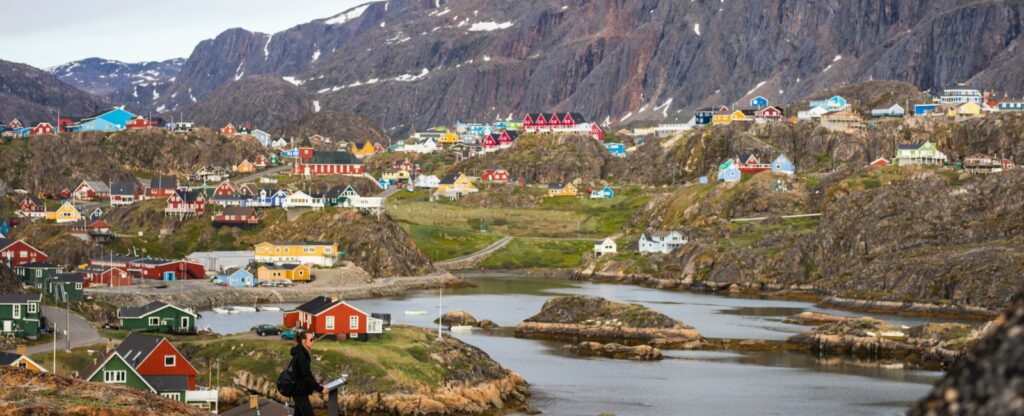
Sisimiut is Greenland’s second largest town and the northernmost, which is ice-free throughout the year, as well as the country’s main fishing port. The town is located 42 km north of the Arctic Circle at the small bay of Kangerluarsunnguaq (Ulkebugten), and the Nasaasaaq mountain (Kællingehætten) is the landmark of the town. Sisimiut means ‘the people at the foxholes’.
Its Danish name was Holsteinsborg named after Count Holstein, who was leader of the mission college which supported Hans Egede’s mission and colonisation work in Greenland.
Sisimiut is the main town of Qeqqata Kommunia. Two smaller fishing settlements belongs to the Sisimiut district as well as Kangerlussuaq, the country’s primary international airport. The three settlements of the district have 627 inhabitants and Sisimiut 5,622.
History of Sisimiut
Due to the living resources of the sea and the good hunting areas for terrestrial mammals along fjords and lakes all the way into the ice sheet, people have lived in the area from the earliest immigrations. During the period about 2,400‑500 BC, the area was populated by the Saqqaq culture. After this and up to about year 0, the Dorset people lived there. Subsequently, the area was uninhabited until the Inuit came to the area around the 1300s.
At the time of Danish colonisation, there was great European whale hunting activity in the area. The first Danish whale hunting station to be constructed on the island of Nipisat was burned down by Dutch whalers. In 1738 and 1739, this led to armed conflicts between the Danish Navy and Dutch whalers. In 1756, the colony of Holsteinsborg was established on the island of Ukiivik (Sydbay) north of present-day Sisimiut, but due to poor hunting and trading opportunities, the settlement was moved to the current location of the town in 1764.
In connection with the establishment of the colony’s port, a gradual industrialisation began. In 1914, the Royal Greenland Trading Department (KGH) opened a saltery for cod, which in 1924 was extended to the preservation of halibut. During the period 1935 to 1949, production was converted to shrimp, after which the shrimp disappeared from the nearby banks. In 1957, a new and larger salt fish plant was constructed, which in 1964 was redirected to frozen cod fillets supplemented by shrimp during periods with limited cod. And in 1962, a private shrimp factory was established, which also traded various fish as well as whale and caribou meat. In 1969, KGH founded another fish factory. In 1970, an actual Atlantic wharf was constructed in the town.

GRØNLANDS STATISTIK
To support the growing fishing industry, Greenland’s first shipyard was established in 1932 to repair large vessels and build new smaller vessels. The yard has since been expanded several times.
In 1941, the US Air Force established the airport Sondrestrom Air Base on the large plain at the head of the 180-km long fjord Kangerlussuaq (Søndre Strømfjord), which ends about 100 km south of Sisimiut. Since the mid-1950s, the airport has also been used for civilian traffic and has served as the primary international airport. A heliport was established in 1964 in Sisimiut to be able to get access to the airport at Kangerlussuaq.
In 1938, Sisimiut had a population of 541, and by 1947 it had increased to 841. The rapid population growth during the modernisation, which meant that the population had reached 3,113 in 1968, resulted in considerable construction activity. In 1969, there were 31 private contractors with 140 employees, primarily from Denmark.
The strong focus on fishing and processing meant that Sisimiut became known as a well-functioning industrial town with an enterprising and hard-working population. The town was therefore chosen as the location of the first high school, Knud Rasmussen’s Højskole, which opened in 1962. Due to the many contractors and the considerable construction activity, the Sanaartornermik Ilinniarfik, the Building and Construction School, was also established in Sisimiut in 1977.
The educational centre of Sisimiut

KÅRE HENDRIKSEN, 2013
The establishment of Sanaartornermik Ilinniarfik was the beginning of Sisimiut becoming one of the country’s most important educational centres. Since then, Sanaartornermik Ilinniarfik has expanded several times and has become the Kalaallit Nunaanni Teknikimik Ilinniarfik (KTI) educational centre, also called Tech College Greenland. KTI-Sisimiut currently offers building and construction programmes, technical college (GUX), the School of Natural Resources and language courses. In 2022, a marine engineer and technology management programme will be started in collaboration with the Copenhagen School of Marine Engineering and Technology Management.
In 2001, the Arctic Technology Centre, ARTEK, was established by the Greenland Home Rule Government in collaboration with the Technical University of Denmark (DTU) and KTI. Here, the first three semesters of the Arctic civil engineering programme are provided, and the centre serves as a base for research projects around the country. The centre has since been expanded to include parts of an international master’s degree programme and a civil engineering programme in fisheries technology.
Sisimiut also has two primary schools.
The many education programmes leave their mark on the town in terms of businesses and culturally, and the town has a total of 400 dorm rooms.
Development and infrastructure of Sisimiut
Architecturally, Sisimiut is a mix of single-family houses, terraced houses and housing blocks erected as part of the Danish centralisation policy in the 1960s. The town is under development and on the other side of the narrow Kangerluarsunnguaq (Ulkebugten), by the road going to the airport, multi-storey housing blocks as well as terraced houses and singlefamily houses have been built over the past decade. Virtually all of the town’s housing is connected to the water supply, and there is plenty of good drinking water in the town’s catchment area. About 80 % of the town has a sewer system, while the remaining inhabitants use sludge tanks that are emptied by vacuum trucks, or toilet buckets and collection of latrines. In 2010, a hydropower plant opened at Sisimiut, and the former diesel-based power plant now operates as an emergency power plant.
Establishment of the domestic airport in 1998 on the north side of Kangerluarsunnguaq led to a significant improvement in passenger and, to a lesser extent, freight transport.
Sisimiut’s main road, Aqqusinersuaq, goes from the harbour in the west and continues out to the open landscape to the east, where most of the town’s sled dogs are located. Several of the town’s shops, the two main supermarkets, hotel and folk high school are located along the road. Most of the town’s road network is paved and paved trails have been established along several of the central roads and there is road lighting in most places.
In 2008, Greenland opened its second cultural centre, the Taseralik Cultural Centre, containing both a cinema and theatre hall.
Since 2002, the municipality has been working to establish a road link between Sisimiut and Kangerlussuaq in order to optimise transport to the international airport and to exploit the potential for tourism in the vast ice-free land area between Sisimiut and the ice sheet. External consultancy reports have documented the positive economic impact of the road despite heavy construction costs, and Qeqqata Kommunia has applied for permission from the Self-Government to establish the road, but the process has been protracted. As a first step, the municipality is currently establishing a trail for ATVs (small off-road vehicles) hoping that the trail can since be extended to an actual road.
Royal Arctic Line’s container ships call at Sisimiut weekly throughout the year. The Arctic Umiaq Line make weekly calls with its coastal passenger ship going north and south, respectively, with Sisimiut being the northernmost town on the route during winter and only southbound connections. On behalf of Disko Line, the local Sirius Greenland company makes weekly passenger trips to the district’s two fishing settlements, and Sirius Greenland offers package trips.
In 2013, Qeqqata Kommunia established an 86-m long port in Sisimiut, including a 10,000 m² storage and working area west of the Royal Greenland fish factory. The new port allows two large ships to be berthed, meaning that a large trawler or cruise ship can call at the same time as Royal Arctic Line’s freighter is at the quay. Sisimiut is an important trawler port used primarily by Greenland trawlers and to a lesser extent by trawlers from other nations fishing in the Davis Strait.
In summer, Sisimiut receives about 40 cruise ships. Many disembark and embark passengers in Kangerlussuaq, after which Sisimiut is the first stop up the west coast, with some continuing to the East Canadian waters or all the way through the Northwest Passage to Alaska. Cruise ships need supplies and oil, which is why it is paramount that they can get to a port. Many studies show that tourists are more likely to disembark, go on tours of the town and buy souvenirs if their cruise ship get to the port – rather than if they have to be sailed ashore in small boats.
Trade and industry in Sisimiut

MADS PHIL/VISIT GREENLAND, 2015
The town’s main source of income is the fishing industry. The country’s largest factory, owned by Royal Greenland, lands and processes cod and crab and employs about 100 people during the off-season and 150 during the peak season. Furthermore, Royal Greenland has a small factory for processing roe, which employs eight during the roe season. Fishing generates a number of related industries such as seine making and shipyards.
The total workforce in Sisimiut is over 2,700 people (2021). In terms of employment, the largest industry is public administration and service, including education and health care, accounting for 40 % of the town’s jobs. Trawler fishing and coastal fishery as well as processing of fish and related industries contribute around 16 % of the jobs. Trade and auto repair account for 13 %, the transport sector 5 %, construction 11 % and other service industries 9 %.
Sisimiut has several private companies within production, construction and service. The government-owned and nationwide companies such as the housing company INI A/S and the utility company KNI A/S are both headquartered in the town. KNI has the following subsidiaries: the country’s largest retail chain, Pilersuisoq, Polar Oil, the webshop pissiffik.gl, KNI Engros and the slaughterhouse in Narsaq, Neqi A/S. All of the subsidiaries, except Neqi, are headquartered in Sisimiut.
The large trawler fishing industry that regularly disembark and embark its crew uses the well-functioning Hotel Sisimiut Sømandshjem (Hotel SØMA) with 32 rooms, which is currently being extended, and the 38-room Hotel Sisimiut, which also offers accommodation in seven hotel flats as well as a restaurant. This is supplemented by private accommodations via Airbnb as well as a handful of cafes and restaurants.
Tourism has become increasingly important to the town. In addition to the enterprising town, its main attraction is the large accessible ice-free land area that goes all the way to the ice sheet. During winter, you can go on dog sled rides for a few hours up to three days if you take the popular ride between Sisimiut and Kangerlussuaq. Other major attractions are cross-country skiing, snowmobiling and most recently fat biking. The annual cross-country skiing event Arctic Circle Race, where participants cover 160 km in three days and sleep in a tent camp for two nights, has up to 200 participants and just as many volunteers.
During summer, tourists go hiking in the local area, take day trips to the abandoned settlement of Assagutaq and the town’s nearby mountains. The 160-km long Arctic Circle Trail hiking route between Sisimiut and Kangerlussuaq is particularly popular. Municipal cabins along the route provide accommodation and safety. During summer, sports fishing in the trout rivers around Sisimiut is very popular.

ASIAQ, 2022
Further reading
- Association activities and volunteering
- Education
- Industry and labour market
- Infrastructure
- Kangerlussuaq
- Maniitsoq
- Qeqqata Kommunia
- Self-Government
- The five regional municipalities
- The ice-free landscapes
- The ice sheet
- Towns and settlements
Read more about the Municipalities and towns in Greenland
